
Blog
Leak repair and post-repair verification
Finding a leak is half the job; the other half is showing the repair actually closed the loss. This article outlines the repair process and post-repair verification.
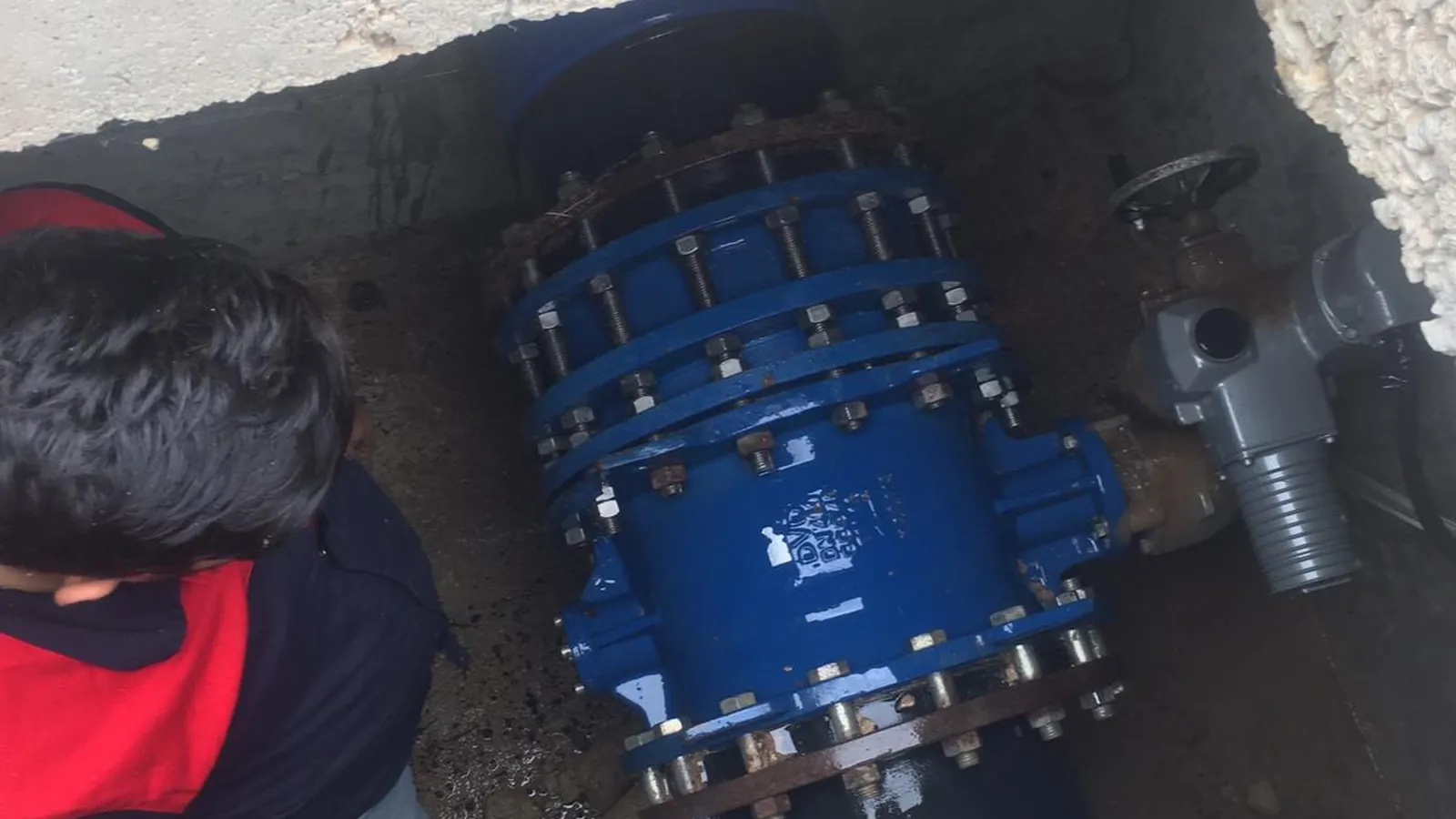
Final confirmation before the dig
Once a leak point has been narrowed down with acoustic detection and correlation, it is listened to once more on site before digging. The spot where the ground microphone is loudest is marked, setting the centre and width of the dig so the excavator opens no wider a pit than needed.
The marking step also confirms the route and depth of the main (see pipe locating). An electromagnetic locator or ground penetrating radar checks the pipe's plan position and burial depth, and the same scan locates other buried services, so another line is not cut during the dig.
The confirmation data goes on the sketch: the point coordinate, the estimated depth, the surrounding services and the surface type. The scope is municipal and organised-industrial-zone distribution networks; the work is on street and arterial mains. This record goes with the excavation request sent to the utility and is the starting reference for verification.
Who does the repair?
The excavation and repair are done by the utility that owns the network — its own crew or its contractor. Road-opening permits, traffic management, the dig, the work on the pipe, backfill and reinstatement are that crew's responsibility. LeakExpert takes no part in this; it does not dig mains and does not replace pipe.
LeakExpert's role sits at two points: point confirmation before the dig — fixing the exact position of the leak and of the main without excavation, so the utility crew opens the right place — and verification after the repair, measuring the night flow again to show whether the loss has actually closed and reporting the recovered loss.
The split has a practical reason: work on a main needs a road closure, a safety plan and network switching, all within the utility's authority. LeakExpert stays on the measurement and verification side and reports the repair result independently, in numbers.
Types of repair
The repair method follows the kind of damage and the condition of the pipe. For a small hole or a narrow longitudinal crack, a repair clamp is used: a gasketed steel band that seats around the pipe and seals the damage without cutting the line, which suits limited, isolated damage.
Where there is a circumferential break, a crushed length, or damage too large for a clamp, the damaged part is cut out and a new pipe section fitted in, joined at each end with a coupling. A leaking fitting, valve or joint is removed and renewed.
If the same length of main shows repeated failures — fatigued material, advanced corrosion — a full renewal of a defined length is considered instead of a spot repair. That decision rests with the utility and draws on the failure history and the age of the pipe.
Testing after the repair
Once the physical work is done, the main is re-pressurised slowly: a sudden rise can create a surge at the new joint and neighbouring connections, so the valve is opened in stages. Once the pressure has settled, the repair point and couplings are checked by eye and hand for wetting or dripping.
Before the pit is closed, the main is flushed: water is run from the open end or the nearest hydrant to carry out soil and dirt that entered during the dig. If contamination is suspected, the section is disinfected and the water quality confirmed with a residual-chlorine reading or a sample, per the utility's practice. Only then are backfill and reinstatement done.
The test observations — the settling time, the joint condition, the flushing time — are noted on the sketch, and the repair point stays as a record on the main for later work.
Verification: night flow again
Whether the repair has really closed the loss is shown by comparing the zone's minimum night flow before and after. That is the flow measured at the zone inlet during the hours of lowest consumption, roughly 03:00–05:00, when most of the flow is physical leakage (see flow measurement, DMA).
A few days later, under similar conditions — same pressure zone, comparable night, known valve state — the measurement is repeated. The drop between before and after is the leak rate closed at that point. A drop of the expected order means the point is closed; no drop means another leak remains.
To see the effect of a single point, the measurement should be on the right section of main and, where possible, in a small zone. In a large zone one small repair can be lost in measurement noise, and a step test may be needed to reach sub-sections.
Reporting
Every repair is entered into the LeakExpert platform with its results: the point coordinate, the repair date as notified by the utility, the type of repair, the night flow before and after, and the recovered loss between the two, so each project gains a measurable record of what was won back.
Points found not to have closed at verification go back on the survey list, taken up again with re-listening, correlation or a step test; points that did close come off the zone's loss balance. Together these records show the progress of a water-loss reduction programme, reported with measured values and without overstatement.
The point-confirmation and post-repair verification routine can be planned over a remote or video call; once the network sketch, measurement records and the utility's repair notifications are shared, the verification plan is set together.
Also on the blog
Related articles.
How to tell if there is a water leak: 8 signs in a network
Signs of a hidden leak in a drinking-water network: rising night flow, pressure drop, a wi…
What is flow measurement, and how is it done in a network?
The purpose of network flow measurement, temporary measurement with a portable ultrasonic/…
Pressure management and pressure zones (PMA)
How high and fluctuating pressure drives leaks and bursts, setting up a pressure managed a…
For your network
Let's measure the loss and pinpoint it.
In a short video call we can review the current situation and the method to apply.