
Blog
What is a zero-pressure test?
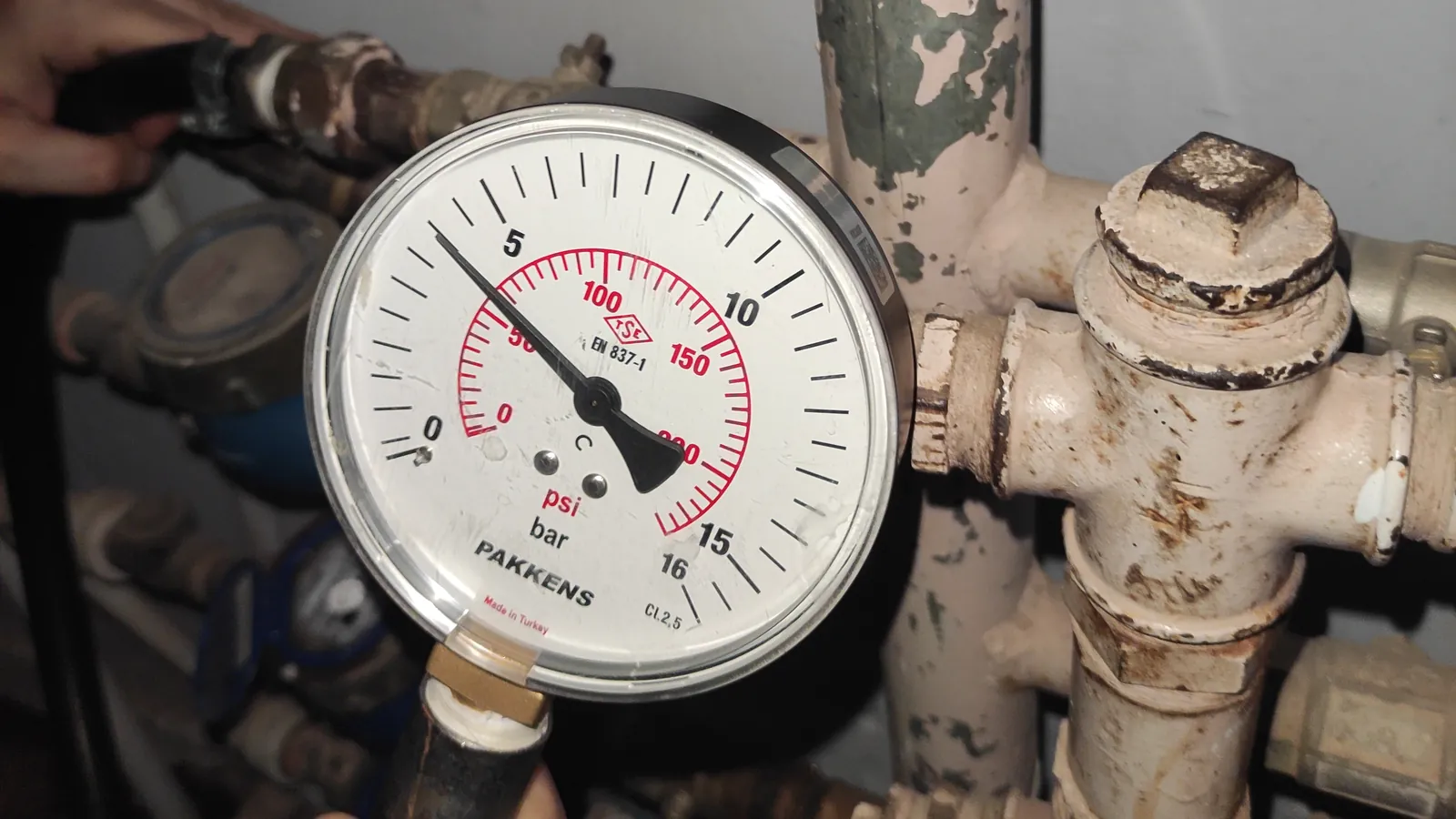
Before a section's night-flow or step-test figures can be trusted, you have to know the section is genuinely isolated. A zero-pressure test isolates it and drops its pressure to zero: if pressure stays flat, the boundary is sealed; if it creeps back, something is feeding water into the section past the isolation.
When is it used?
A zero-pressure test is a preliminary check on whether a length of main is genuinely isolated — whether its boundary valves seat tight and no unrecorded feed runs into it. It is run before a section's night-flow or step-test figures are trusted, or when a DMA will not balance and the boundary is suspect. A step may, for instance, come out larger than expected; whether that is a real loss or a feed leaking past the boundary cannot be told apart until the length is tested on its own.
The method suits a short, clearly bounded length: a section between two boundary valves, no more than a few hundred metres, with known connections. The longer the length, the harder it is to isolate and the murkier the interpretation. The scope is municipal and organised-industrial-zone distribution networks; the test is designed for mains and zone pipes.
Isolating the section
The first step is to separate the length under test completely from the network. The boundary valves at each end are closed and each is verified to seat tight. If a boundary valve will not close, or passes a little water, that already shows the length is not genuinely isolated — exactly what the test measures. Even so, every valve is made as tight as possible, since telling which path feeds the pressure back depends on it.
Valve tightness is checked where possible by watching the pressure fall behind the valve, or by observation at the washout. A pressure recorder (data logger) is connected to the isolated length; it logs pressure at short intervals throughout the test. Where the length has more than one measuring point, the reading is taken at the lowest elevation and farthest from the boundary valve.
Dropping the pressure to zero
Once the length is isolated, the water inside it is drawn down in a controlled way through a hydrant or a washout point. The draw-down is done slowly: a sudden opening sends a pressure surge through the main and disturbs sediment on the pipe wall. The pressure recorder is watched until the value reaches zero.
When the pressure reaches zero, the washout is throttled back and a short wait lets the water level inside the length settle. The aim is to establish a starting state in which the length is fed from no external source and the internal pressure is genuinely zero. After that, the washout is closed completely.
Observation
With the washout closed, the recorder keeps logging. If the pressure stays flat at zero, no path feeds the length from outside: the boundary has seated tight and the length is genuinely isolated, so its night-flow and step-test figures can be trusted. This does not prove the length is leak-free — a leak is an outflow, so it too reads a flat zero.
If the pressure creeps back up, a path is still letting water in. A hole in the pipe wall is an outflow path; it cannot raise the pressure of a drained, isolated length. Pressure returning can therefore only mean an inflow path the isolation failed to close. The rate of rise roughly indicates how much is getting in. Observation continues until the trend is clear; a brief glance can mislead.
Interpreting the result
A zero-pressure test is not a leak test but an isolation, or boundary-integrity, check. The result is read in one of two ways.
If the pressure stayed flat at zero, the boundary is tight and its DMA night-flow and step-test figures can be trusted. If the night flow is nonetheless high, the loss is genuinely on that length, which is then handed to the acoustic crew for pinpointing.
If the pressure returned: something is feeding the length past the isolation — typically a boundary valve that will not fully close, an unmapped service connection, or a cross-feed from an adjacent zone. The work now is to close and reopen the boundary valves one at a time until the one that stops the return is found, and to check the network map against the ground. Finding an unmapped feed is itself a valuable result, since unrecorded connections are a common reason a DMA will not balance. Until the boundary is tight, the length's flow figures are treated as untrustworthy.
Safety and water quality
Dropping the pressure to zero can create negative pressure for a time, in the isolated length and in the neighbouring network. Negative pressure can draw contaminated water in from the ground through connection points (back-siphonage). For this reason the draw-down is controlled, the length is not left unpressurised longer than needed, and the main is re-pressurised as soon as the work is done.
Re-pressurising is done slowly: the valve is opened in stages, air is expelled at the vent points, and pressure is brought back to its normal value gradually. The length is then flushed from a hydrant; if turbidity or discolouration persists, flushing is extended and disinfection applied if needed. Connections affected by the test are notified in advance and the interruption window is kept short. Results are reported without overstating certainty — as “boundary tight, the section's flow figures can be trusted”, “a feed is getting in past the isolation, its source is being traced”, or “the trend was not clear, a repeat is needed”.
Also on the blog
Related articles.
How to tell if there is a water leak: 8 signs in a network
Signs of a hidden leak in a drinking-water network: rising night flow, pressure drop, a wi…
What is flow measurement, and how is it done in a network?
The purpose of network flow measurement, temporary measurement with a portable ultrasonic/…
Pressure management and pressure zones (PMA)
How high and fluctuating pressure drives leaks and bursts, setting up a pressure managed a…
For your network
Let's measure the loss and pinpoint it.
In a short video call we can review the current situation and the method to apply.